
CRO Handover · 20 October 2026 · 2 min read
Page 7: How long a new representative takes to produce
A new CRO should measure sales development ramp by the pipeline value a new representative creates and an account executive progresses, not by onboarding completed or meetings booked. Page seven of the Handover File tests Rep Readiness against the revenue plan.
By Jeremy Heap, Founder, RepAgentic
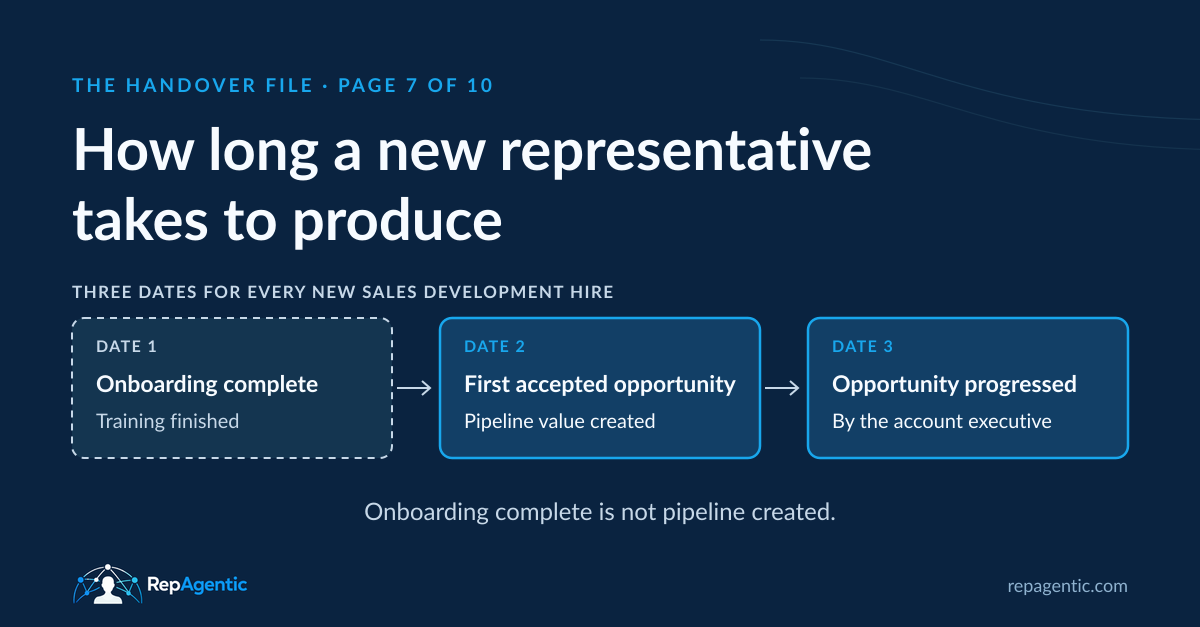
Ask when the last sales development hire finished onboarding. Then ask when they created their first accepted opportunity, and when an account executive moved it to the next stage.
Those are three different dates. Only the last two tell you whether the hire is adding to pipeline.
A hire can finish every module on time and still produce no accepted pipeline for months. The plan rarely notices until the quarter it was counting on.
What should a new CRO measure when representatives ramp?
Track each recent hire from start date to first accepted opportunity, then to the first opportunity that progresses beyond acceptance. Record the pipeline value at each step.
Meetings booked and calls made show effort. Pipeline value accepted, then progressed, shows whether that effort reaches the revenue plan.
Then compare hires. If one representative ramps quickly and the others don't, look at the territory, the accounts assigned and the coaching they received. If every hire takes the same long route, the issue is onboarding, not the people.
Ramp is a revenue plan assumption
In RepAgentic's framework, Rep Readiness covers whether representatives are enabled and coached to run the motion, and how quickly a new hire reaches productivity. Page four followed how the sales development team is paid. This page checks how soon a new hire produces pipeline worth paying for.
The revenue plan almost always assumes a ramp. Check that assumption against real dates and pipeline value before approving the next hire.
Next, page eight: which forecast numbers you can trust.
Onboarding complete is not pipeline created.
Where this starts
Is your ramp assumption built on real dates?
The free Outside-In Read examines your public go-to-market and identifies visible gaps and where to look first. It cannot see your hiring dates, accepted opportunities or pipeline value. Those need internal evidence through Inside-Out Verification. Start with the free read, then decide what to examine next.