Rebuild
0 to 40%No written target market, or one nobody uses. SDRs pick accounts by instinct or from last year's list. Two people would choose different companies.

Built for B2B revenue leaders accountable for new-business pipeline
Best fit: Established sales development team or building your first.
We diagnose how your sales development team creates pipeline and how your account executives convert it, and name the first area to fix, before you spend on AI SDRs, tools, hires or agencies.
Start free. The Outside-In GTM Diagnostic works from public evidence and eight questions, and your brief arrives within one business day. It says what we could see, what we could not, and what a verified diagnosis with your team and your CRM would take.
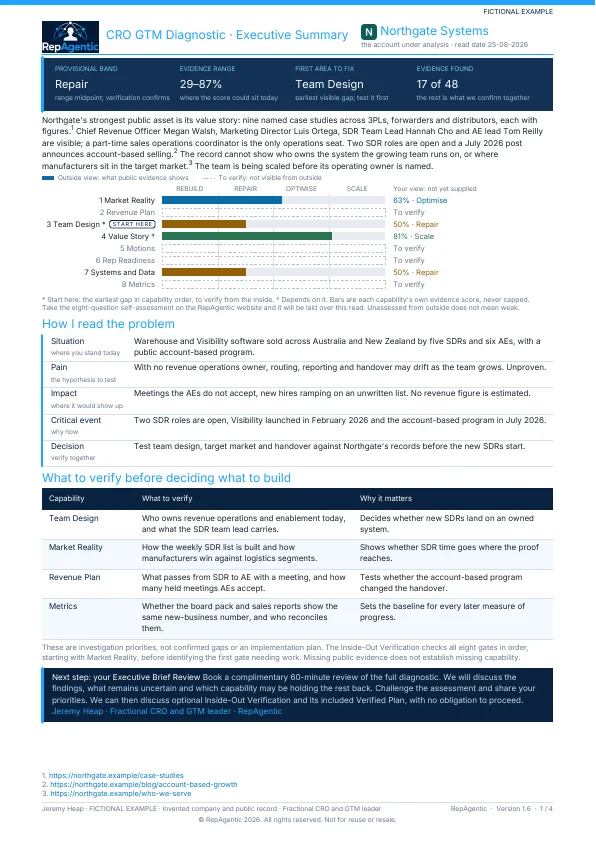
Your new-business pipeline engine. Sample for a fictional company, Northgate Systems. What you were told at handover: world-class, all eight capabilities rated green. The outside view from the Outside-In GTM Diagnostic: Repair, 58%, provisional, could be 29 to 87%, with Team Design as the first area to fix. Verified from inside against your own evidence: Repair, 59%. One of eight claims holds up, and the first fix moves to Market Reality because two market definitions disagree and there is no qualified-account test. Where you land: 59% Repair on the maturity curve, next band Optimise by 23 November 2026. Expected outcomes: qualified pipeline grows from $13.3M to $17.0M a year, 214 to 250 opportunities, median days from opportunity to close fall from 94 to 80, and new-business revenue grows from $4.1M to $5.2M a year. Then fix it in the right order.
 See the sample Executive Brief
Results from Jeremy's previous global role, 2020 to 2025.
Growth usually stalls at one gap further up the chain. Hiring or buying tools before that gap is fixed spends money on the symptom.
Pipeline reports, activity numbers and a full CRM can all hide the real constraint.
More reps or new software arrive before the market, the plan and the handover are settled.
If the target market isn't written down, the team, the message and the metrics all inherit the problem.
We check eight capabilities, in the order they need to be built. See the eight on the CRO GTM Diagnostic page
We score each capability and name the first one to fix.
The plan repairs it with the people you have, dated to their real hours.
Roles that are missing or stretched are named, with an action to cover them.
No sales development team yet, even if your account executives prospect for themselves.
We look at your routes to revenue and what a first seat would cost and return.
The plan chooses the seat: hire, fractional, outsourced or founder-led with support.
It sets a six-month test: keep, change or stop.
What you get free
Where the public record places you, and the evidence range behind it.
The earliest capability with a visible gap, and the one to test first.
A structured view of what is proven, open and proposed.
What your internal evidence needs to confirm or correct.
No sales development team yet? You receive a Greenfield Brief instead: your routes to revenue and what a first seat would cost and need to return.
Each route produces four documents. These are examples made for two invented companies, so you can see the format and depth before you talk to us. The first two documents in each route are shown in full. The Verified Plan and GTM Build Pack are short samples. Clients keep the full versions. A 60-minute review of the diagnostic findings is included, and optional. The brief arrives whether or not you book it.
Example company: Northgate Systems, a fictional software company with an established sales team.
Four pages from public evidence: where the account stands, the first area to fix and the questions to verify.
The account on the public record and the Market Reality capability in full. The other capabilities are summarised.
Selected pages: the answer, who is accountable for what, the account summary, two capability pages and a page of the dated action list.
Selected pages: a Market Reality workshop deck set up for the account, a workbook page and the module guide.
Both companies, their people and their figures are invented. Every page is marked "Fictional example". © RepAgentic 2026. All rights reserved. Not for reuse or resale.
Market Reality: who you target and how you choose accounts. Each of the eight capabilities is scored the same way.
No written target market, or one nobody uses. SDRs pick accounts by instinct or from last year's list. Two people would choose different companies.
A definition exists, but teams work from different versions. Marketing's and sales' lists only partly overlap. Some meetings come from companies outside the target.
One dated definition with a named owner, used by marketing and SDRs alike. Two people choose the same companies. Each account is marked in the CRM as in or out of the target.
The definition is reviewed each quarter against wins, losses and the pipeline that moved forward. The share of pipeline from target accounts is tracked. New signals, such as hiring or a product launch, add accounts, with a person signing off.
Why it matters: each step up means more of your pipeline comes from companies you can win, so more opportunities reach later stages and deals are worth more.
An example of how one capability is described. Your own score comes from your evidence.
Where the public record is thin, the band is provisional, and verification confirms it.
Ready to see where your pipeline stands?
Get your free Outside-In GTM DiagnosticHow it works
Everything starts with the free diagnostic. What follows depends on what it finds.
Your team runs it. We are not the dependency.
See what a one-band move could be worth to you.
Open the growth calculatorReady to see where your pipeline stands?
Get your free Outside-In GTM Diagnostic
Who you are working with
In his previous global role, from 2020 to 2025, Jeremy grew an account development team from 15 to 60 reps, its yearly pipeline from USD 20M to USD 450M, and yearly revenue won from SDR-sourced pipeline from USD 500K to USD 45M.
RepAgentic finds what is really holding back your sales pipeline, starting from public evidence, verifies it with your team, and fixes it in the right order, so pipeline, conversion and revenue growth follow.
More about JeremyThe first step
Eight quick questions, then your brief within one business day, prepared from public evidence only. A 60-minute review of the findings is included, and optional. The diagnostic is yours to keep.
Not ready yet? See example documents for two fictional companies.
A note on fit: No sales development team yet? The diagnostic still works. It becomes a Greenfield Brief on what a first seat would cost and need to return.
Step 1 of 3: contact details
Three short steps. Public information only; nothing is needed from your systems.
Eight quick answers, about three minutes. This is your view from the inside. Your diagnostic tests it against your public record and shows both side by side.
If you're unsure, choose the lower option. Uncertainty is itself a finding.
For example: "Just hired four SDRs" or "Missed Q2 by 30%". Add it and it goes with your Outside-In GTM Diagnostic request, so the diagnostic starts from what matters to you.
0 of 8 answered
Step 2 of 3
Expect your brief within one business day. Public information only; no access to your systems.
If you would like to talk through your request or share anything else I should know, you can book an optional 15-minute call.
No call is needed to receive your brief within one business day.
Book an optional 15-minute call