
CRO Handover · 22 October 2026 · 2 min read
Page 9: Which dashboard numbers deserve attention
A new CRO should keep the dashboard numbers that change pipeline decisions and question the rest. For sales development, Expected Pipeline, or xP, turns accepted pipeline value and progression into one percentage. Page nine tests Metrics.
By Jeremy Heap, Founder, RepAgentic
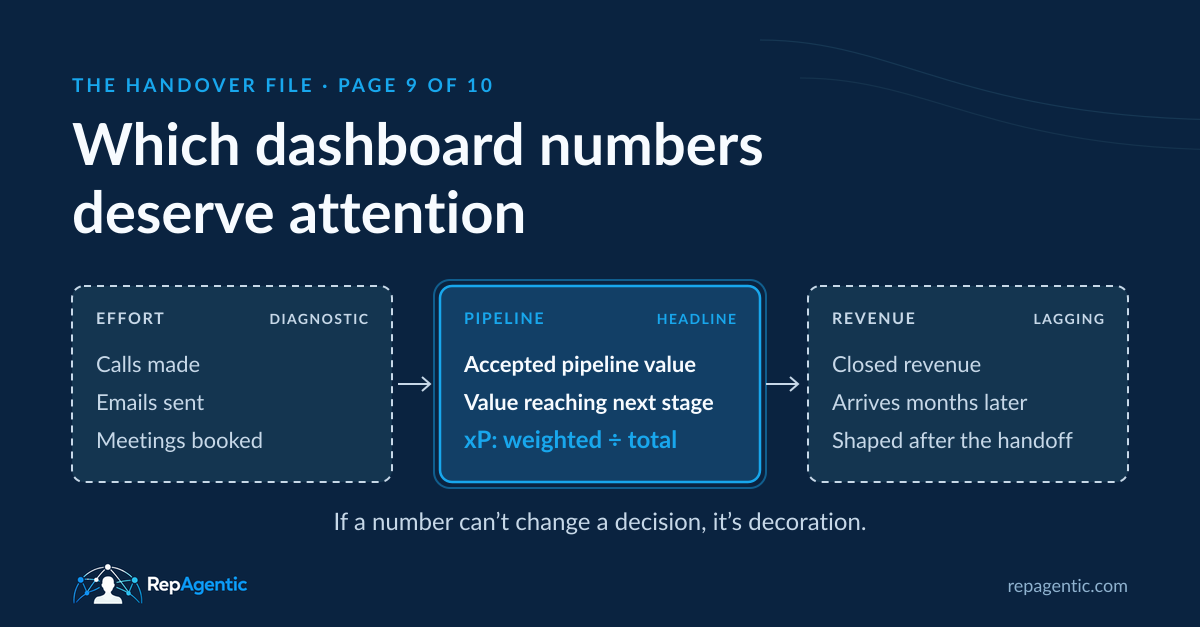
Ask each number on the sales development dashboard one question: what decision did this change last month?
Calls, emails and meetings booked show effort, but a busy week can still produce no accepted pipeline.
Closed revenue arrives months later, shaped mostly after the handoff.
Which numbers should a new CRO watch for sales development?
Start with accepted pipeline value: opportunities an account executive has agreed to work. Then track how much reaches the next agreed stage.
When I developed Expected Pipeline, or xP, at a global enterprise software company, I combined the two into one percentage: stage-weighted pipeline value divided by total pipeline value. Pipeline that moves raises the percentage. Pipeline that sits still doesn't.
Because it's a ratio, it compares sales development representatives, account executives, products, teams and regions on the same terms.
Keep activity as a diagnostic. When xP drops, activity helps explain why.
Fewer numbers, more decisions
Metrics, in RepAgentic's framework, asks whether measures reflect the work that produces revenue and drive action. Page four used xP to reward pipeline that moves. Page eight showed why comparisons need a common starting point.
xP also depends on trusting the stage. Some account executives stage opportunities ahead of the evidence; others hold them back despite it. That trust is set at the outset: clear qualification standards, and a service level agreement holding sales development and account executives to them. Get both right, then manage and measure them, and xP reflects progress, not opinion.
If a number hasn't changed a decision in a quarter, move it off the main view.
Next, page ten: the first thing to fix.
If a number can't change a decision, it's decoration.
Where this starts
Which numbers on your dashboard change decisions?
The free Outside-In Read examines your public go-to-market and identifies visible gaps and where to look first. It cannot see your dashboards, accepted pipeline value or your xP by team or region. Those need internal evidence through Inside-Out Verification. Start with the free read, then decide what to examine next.